
By Adrian H. Halili, Reporter
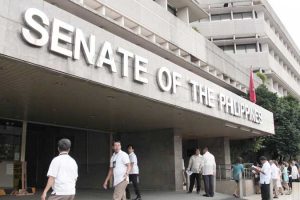
THE SENATE approved the proposed P6.793-trillion national spending plan for 2026 on third reading late Tuesday, amid heightened scrutiny over the budget process following the cloud hanging over infrastructure spending and alleged budget “insertions.”
In plenary session, 17 senators voted to pass the chamber’s 2026 General Appropriations Bill, which re-channeled funding from public works to education, health, and emergency preparedness.
Next year’s spending plan is 7.4% higher than this year’s P6.352-trillion budget and equivalent to 22% of gross domestic product.
Economic managers ruled out economic growth hitting the government’s 5.5%-6.5% full-year target, following a 4% reading in the third quarter.
“In our long discussions, we revisited two important goals. First, to strengthen government programs to meet the needs of our countrymen, and second to keep (the budget process) open and free from any form of corruption,” Sen. Sherwin T. Gatchalian, who heads the Finance Committee, told the Plenary.
Senators approved the P53.99 billion reduction in the budget of the Department of Public Works and Highways (DPWH) to P570.58 billion. The House version of the spending bill had called for DPWH funding of P624.48 billion.
“One of the major amendments to the DPWH budget was the use of adjustment factors in the costing of infrastructure projects following the President’s directive to drive down the cost of construction materials,” Mr. Gatchalian added.
Mr. Gatchalian said that as all infrastructure projects will now be more closely tracked to avoid the recurrence of so-called “ghost projects,” which emerged after inspections of flood control projects turned up many works that were substandard or non-existent.
The Senate raised funding for education to P1.375 trillion. The House version of the budget bill had called for education funding of P1.283 trillion.
The classroom construction budget was raised to P65.93 billion from the P46.68 billion stipulated by the House. The classroom construction budget will fund more than 24,000 classrooms.
Funding for the School-based Feeding Program was also raised to P28.66 billion from the P13.61 billion specified by the House. The funding is good for 200 school days, benefiting 4.8 million students.
The Senate also raised funding for State Universities and Colleges to P139.04 billion from P131.69 billion in the House budget bill.
The Senate also raised funding for the government’s Zero Balance Billing program — which subsidizes hospital care — to P62.66 billion from the House’s P53.3 billion.
“With this additional funding, more patients in basic or ward accommodations will be able to receive medical services without out-of-pocket costs,” he added.
The Finance committee also allocated P1 billion to fund the pilot testing of the Zero Balance Billing in selected hospitals, with funding overseen by local government units.
The budget for specialty government hospitals also rose to P13.55 billion from the P6.66 billion allocated by the House.
The National Disaster Risk Reduction Management Fund allocation was also raised to P44.1 billion from the P29.25 billion set aside by the House.
“The amendments to education, health, and emergency response are anchored on one fundamental virtue: that government’s greatest obligation is to the welfare of its people,” Mr. Gatchalian said.
Legislators approved the national budget after 47 days of committee and plenary debate as public concern intensified regarding the opaqueness of the budget process coupled with the alleged involvement of senior legislators in siphoning off billions from flood control funds.
Legislators from both Houses are now expected to convene the Bicameral Conference Committee to harmonize the Senate and House budget bills.
The Senate Finance committee has said that it will no longer allow insertions during the bicameral conference.
Bicameral meetings are scheduled for Dec. 12-14, followed by ratification on Dec. 19, according to the Senate’s revised calendar.
“Given the corruption scandals involving many legislators, greater public scrutiny of the budget is needed more than ever,” according to Joy G. Aceron, convenor-director of transparency group G-Watch. Speaking to BusinessWorld via chat, she added: “It’s yet to be seen whether Congress budget deliberations and budget implementation will be more transparent.”
Ederson DT. Tapia, a political science professor at the University of Makati, said the government’s transparency initiatives remain “surface level.”
“The real test is whether citizens, journalists, and independent analysts can actually trace how items enter, change, or disappear across the budget cycle. Until that level of visibility exists, reform remains more symbolic than substantive,” he said via chat.
The Senate ordered all 2026 budget documents — including transcripts, hearings and briefings — to be posted online.
The Palace has indicated that bicameral conference committee meetings will be livestreamed.
Ms. Aceron also warned that corruption will persist if transparency reforms stall or remain superficial.
“Corruption… could get worse if we are unable to realize the necessary reforms,” she added.
Mr. Tapia noted that opaque budget insertions may return, prompting further erosion of public trust in Congress.
“People already view the budget as vulnerable to political bargaining. If reforms do not deepen, every controversy will feed that perception, and Congress will struggle to rebuild legitimacy,” he added.