
THE deficit in the agricultural goods trade narrowed 15.1% in October to $932.97 million, according to preliminary data from the Philippine Statistics Authority (PSA).
The decline in the agricultural trade deficit reverses the 17.1% expansion recorded last year.
Agricultural exports in October rose 0.6% year on year to $755.58 million, accounting for 10.2% of total exports. As a share of the $2.44 billion in two-way trade in farm products, exports accounted for 30.91%.
Imports of agricultural commodities in October dipped 8.7% year on year to $1.69 billion, accounting for 15% of overall imports.
Two-way agricultural trade in October declined 6% year on year.
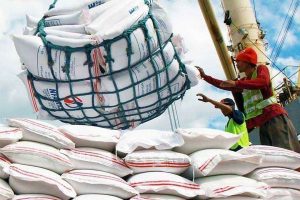
According to an analyst, the contraction in the trade deficit can be attributed to the ban on rice imports.
“The biggest contributor to the decline in imports is rice due to the temporary import ban to possibly increase farmgate prices of palay (unmilled rice),” Danilo V. Fausto, president of the Philippine Cham-ber of Agriculture and Food, Inc., told BusinessWorld via Viber.
Imports of cereals, which include rice, wheat and corn, declined 45.76% from $536.31 million in October last year. Cereals accounted for the largest share of agricultural imports in October, totaling $290.92 million or 17.2%.
Agricultural exports are expected to rise again in 2026 once the Philippines resumes rice imports starting January.
The PSA said the country’s top export commodities during the period were edible fruit and nuts, peel of citrus fruit or melons, valued at $237.97 million, and accounting for 31.5% of agricultural exports.
Agricultural shipments to members of the Association of Southeast Asian Nations (ASEAN) in October hit $77.79 million, with top buyer Malaysia accounting for $31.52 million or 40.5% of the total.
Exports to the Netherlands, the Philippines’ top destination for agricultural commodities in the European Union (EU), amounted to $160.71 million or 51.3% of Philippine farm exports to the region.
Indonesia was still the leading supplier of agricultural products to the Philippines within ASEAN, accounting for $164.65 million or 29.6% of total imports from the region.
The top agricultural goods imported from ASEAN included animal, vegetable, or microbial fats and oils and their cleavage products; prepared edible fats; animal or vegetable waxes.
Within the European Union (EU), Spain was the Philippines’ top supplier of agricultural commodities, with imports valued at $32.40 million, accounting for 23.1% of agricultural imports from the bloc.
The top agricultural goods imported from the EU included meat and edible meat offal. — Vonn Andrei E. Villamiel