
THE Japanese government said disaster-response technologies like ultracompact radar systems and emergency shelters can help countries like the Philippines become more resilient in the face of rising climate and disaster risks.
Misumi Takahito, director of global communications of the Cabinet Secretariat of Japan, said at an online briefing that disaster response is not just a national concern, but a shared responsibility across the region.
“These challenges are not unique to Japan. With a globalized supply chain, a disaster in one country inevitably affects other countries. This is why Japan believes reducing disaster risks in other countries or regions is a matter of shared security and prosperity,” he said.
He added that strengthening disaster resilience across Asia benefits all nations, with Japan seeking to co-create solutions with partner countries and sharing approaches to address common problems.
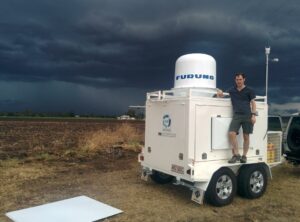
The first of these innovations is an ultracompact weather radar developed by Furuno Electric Co., Ltd., designed to improve localized disaster prediction.
According to Kawakita Soshi, a representative from Furuno’s international marketing department, traditional large-scale weather radar monitors rain clouds over broad regions and higher altitudes, making it difficult to forecast sudden, localized events.
“When you install a big weather radar, there will always be gaps,” Mr. Kawakita said, citing, for instance the blind sports that occur when installing such facilities on mountaintops.
Furuno’s radar set, measuring 1 meter in diameter and weighing 65 kilograms, can be installed in narrow or low-lying spaces such as building rooftops or mountain valleys, allowing highly accurate detection of rainfall at altitudes between 500 and 2,000 meters.
Mr. Kawakita said installation and operating costs are competitive, requiring low power, easy transport, and no dedicated tower or control room, making it suited for developing countries with limited infrastructure and financial resources.
“Our radar compared to a large-scale radar is very small, meaning it is simply structured; therefore, our agents can train you on the ground, and this can alleviate many challenges on the ground,” he said in Japanese.
Meanwhile, the “Instant House,” a disaster-response technology developed by Kitagawa Keisuke, a professor with the Nagoya Institute of Technology, is designed to provide evacuees safe, private and rapidly deployable living spaces after disasters.
According to Mr. Kitagawa, the Instant House addresses challenges in evacuation shelters, including overcrowding, lack of privacy, and slow construction times.
The shelter comes in two versions. The outdoor model, made from a tent-like membrane, can house up to 10 people and can be erected in one to two hours using a blower to inflate the dome and a layer of polyurethane foam for insulation.
The indoor model, made from cardboard, can be installed in about 15 minutes by a single person, offering private spaces in gymnasiums or other shared shelters while isolating evacuees who may be carrying infectious diseases.
Mr. Kitagawa said both versions are highly insulated, maintaining comfortable temperatures and minimizing external environmental impacts.
He said Japanese and Philippine conditions are roughly comparable — “many islands,” making the shelters easily transportable by small boat.
“There are many natural disasters like typhoons in the Philippines; it’s very important to prepare for disasters,” he said.
Mr. Kitagawa compared the cost of the shelters to that of “building an agricultural greenhouse. The cost might be equivalent or even cheaper,” he said.
Mr. Misumi of the Japanese Cabinet Secretariat said Japan is looking to collaborate with partner countries to share expertise and solutions.
“We’d like to see a win-win situation for both Japan and partner countries facing common challenges by leveraging Japan’s expertise in this field,” he said. — Vonn Andrei E. Villamiel