
By Heather Caitlin P. Mañago
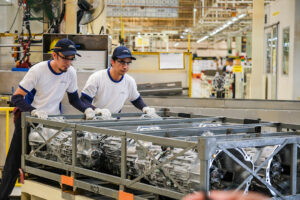
FACTORY OUTPUT rose to a nine-month high in October, driven by seasonal demand, monetary policy easing and rise in exports.
Preliminary results of the Philippine Statistics Authority’s (PSA) latest Monthly Integrated Survey of Selected Industries indicated that factory output, as measured by the volume of production index, grew 1.4% year on year in October.
This was higher than the revised 0.8% expansion in September and a reversal from the revised 1.2% contraction a year earlier.
The latest reading was also the strongest in nine months or since the 2.2% expansion in January.
Month on month, factory output in October grew 4.7%, a turnaround from the 2.2% drop in September. Stripping out seasonal factors, it fell 0.5%.
In the first 10 months, factory output declined 0.3%, reversing the 1.3% year-earlier rise.
The PSA attributed the expansion in October factory output to an acceleration in growth of computer, electronic and optical products (18% in October from 4.2% in September); wood, bamboo, cane, rattan articles, and related products (15.8% from -5.7%); and a moderated decline in chemicals and chemical products (-24.3% from -32.3%).
Eleven other categories recorded expansions, while eight declined.
The PSA said the three largest contributors to the year-on-year acceleration in VoPI growth were computer, electronic and optical products (18% from 4.2%), food products (9% from 4.1%), and basic pharmaceutical products and pharmaceutical preparations (22.6% from 10.6%).
The Philippine S&P Global Manufacturing Purchasing Managers’ Index (PMI) had expanded to 50.1 in October from 49.9 in September.
PMIs are a leading indicator for factory activity, reflecting the volume of raw materials purchased in advance of manufacturing operations weeks or months down the line. A reading above 50 separates expansion from contraction.
The PSA also reported that in October, capacity utilization averaged 77.5%, against the revised 77.2% in September and the year-earlier 76.2%.
Cid L. Terosa, senior economist at University of Asia and the Pacific, attributed the growth in factory output to better weather compared to a month earlier, seasonal demand, and monetary policy easing.
Meanwhile, Philippine Chamber of Commerce and Industry Chairman George T. Barcelon attributed the increase to an uptick in exports and seasonal demand.
The Philippines posted a trade deficit of $3.83 billion in October, 34.2% narrower than the year-earlier deficit, according to preliminary data.
Exports increased 19.4% to $7.4 billion while imports fell 6.5% in October from a year earlier to $11.2 billion.
Both analysts indicated that monetary policy easing may have boosted production by reducing borrowing and financing costs for certain industries.
In October, the Bangko Sentral ng Pilipinas cut its policy rate for a fourth straight meeting, bringing borrowing costs to their lowest in three years.
The Monetary Board reduced the target reverse repurchase rate by 25 basis points (bps) to 4.75%, the lowest since September 2022.
The central bank has now lowered borrowing costs by 175 bps since it began its easing cycle in August 2024.
In the following months, Mr. Terosa said factory output could be influenced by “weak consumer and export demand.”
He also added that some risks include disruptions in manufacturing operations due to weather disruptions, coupled by domestic economic uncertainty arising from corruption and governance issues.
In the third quarter, household final consumption expenditure, which accounts for over 70% of the economy, grew 4.1%, slowing from 5.3% in the second quarter. This brought the nine-month average to 4.9%.
He cautioned that these factors “will probably continue in December.”
“Traditional holiday-season spending will most likely offset this trend, providing a short-term boost to sluggish manufacturing activity,” he said.